What Problem Is Douglass Referring to in This Excerpt?
Coordinates: 43°09′22″Due north 77°36′47″W / 43.1562269°Due north 77.6129184°W / 43.1562269; -77.6129184

Frederick Douglass circa 1852

The 1852 pamphlet printing of the speech
"What to the Slave Is the Fourth of July?"[1] [2] is the title now given to a speech communication by Frederick Douglass delivered on July v, 1852, at Corinthian Hall in Rochester, New York, at a coming together organized by the Rochester Ladies' Anti-Slavery Society.[three] The speech is mayhap the most widely known of all of Frederick Douglass' writings salve his autobiographies. Many copies of one section of it, outset in paragraph 32, take been circulated online.[four] Due to this and the variant titles given to it in diverse places, and the fact that it is called a July Fourth Oration but was really delivered on July 5, some confusion has arisen virtually the date and contents of the speech. The oral communication has since been published under the above title in The Frederick Douglass Papers, Series One, Vol. 2. (1982) [5]
While referring to the celebrations of the Independence Day in the United states the 24-hour interval before, the speech uses biting irony and bitter rhetoric, and astute textual assay of the Constitution and Declaration of Independence, and the Christian Bible, to accelerate a values-based statement against the continued existence of Slavery in the United States.[6] Douglass orates that positive statements virtually American values, such as freedom, citizenship, and freedom, were an offense to the enslaved population of the U.s.a. considering of their lack of freedom, liberty, and citizenship. Every bit well, Douglass referred not only to the captivity of enslaved people, merely to the merciless exploitation and the cruelty and torture that slaves were subjected to in the United States.[7] Rhetoricians R.Fifty. Heath and D. Waymer chosen this topic the "paradox of the positive" considering it highlights how something positive and meant to exist positive can also exclude individuals.[7]
Views expressed in the speech [edit]
The fourth of July Address, delivered in Corinthian Hall, by Frederick Douglass, is published on adept paper, and makes a neat pamphlet of forty pages. The 'Address' may be had at this part, price ten cents, a unmarried copy, or six dollars per hundred.
—Advertisement for the pamphlet of Douglass' speech from the July 12, 1852 edition of Frederick Douglass' Newspaper (formerly The North Star)
Douglass said that the fathers of the nation were great statesmen, and that the values expressed in the Declaration of Independence were "saving principles", and the "ringbolt of your nations destiny", stating, "stand up by those principles, be true to them on all occasions, in all places, against all foes, and at whatever toll." However, he maintained that slaves owed nil to and had no positive feelings towards the founding of the U.s.. He faulted America for utter hypocrisy and betrayal of those values in maintaining the institution of slavery.
What have I, or those I represent, to practise with your national independence? Are the corking principles of political freedom and of natural justice, embodied in that Declaration of Independence, extended to us?...What, to the American slave, is your 4th of July? I answer; a day that reveals to him, more than than all other days in the yr, the gross injustice and cruelty to which he is the constant victim.[8]
Douglass also stresses the view that slaves and free Americans are equal in nature. He expresses his belief in the speech that he and other slaves are fighting the same fight in terms of wishing to be costless that White Americans, the ancestors of the white people he is addressing, fought 70 years before.
They were statesmen, patriots, and heroes, and…with them, justice, liberty, and humanity were final; not slavery and oppression.[9] : 340
Douglass likewise says that if the residents of America believe that slaves are "men",[9] : 342 they should be treated as such. True Christians, co-ordinate to Douglass, should not stand up idly by while the rights and freedom of others are stripped away.
Douglass denounces the churches for betraying their own biblical and Christian values. He is outraged past the lack of responsibility and indifference towards slavery that many sects have taken around the nation. He says that, if annihilation, many churches actually stand behind slavery and support the continued existence of the establishment. Douglass equates this to being worse than many other things that are banned, in particular, books and plays that are banned for infidelity.
They catechumen the very name of religion into an engine of tyranny and brutal cruelty, and serve to confirm more infidels, in this historic period, than all the infidel writings of Thomas Paine, Voltaire, and Bolingbroke put together have done.[9] : 344
Nevertheless, Douglass claims that this can change. The United States does not have to stay the style information technology is. The land can progress like it has before, transforming from beingness a colony of a far-away male monarch to an independent nation. Great United kingdom, and many other countries of that time, had already abolished slavery from its territories. The British achieved this through religion or more specifically, the church. Because the church stood behind the determination to cancel the selling and buying of people, then did the rest of the country. Douglass argues that religion is the center of the problem but as well the main solution to information technology.
Douglass believed that slavery could be eliminated with the back up of the church, and also with the reexamination of what the Bible was actually saying.
You profess to believe, "that, of one blood, God made all nations of men to dwell on the face of all the earth," and hath commanded all men everywhere to beloved ane another; yet you notoriously hate (and celebrity in your hatred) all men whose skins are not colored similar your own.[9] : 345
Douglass wants his audition to realize that they are not living up to their proclaimed behavior. He talks well-nigh how they, existence Americans, are proud of their state and their religion and how they rejoice in the name of liberty and freedom and nonetheless they do not offer those things to millions of their country's residents.[9] : 345
He employs irony to do a lot of this piece of work. Douglass spends time celebrating the efforts of the founding fathers of America for fighting back against the tyranny of England when he says[ten]
Oppression makes a wise human mad. Your fathers were wise men, and if they did not go mad, they became restive nether this treatment. They felt themselves the victims of grievous wrongs, wholly incurable in their colonial capacity. With brave men there is always a remedy for oppression. Just here, the thought of a total separation of the colonies from the crown was born! It was a startling idea, much more then, than we, at this distance of time, regard information technology. The timid and the prudent (as has been intimated) of that mean solar day, were, of course, shocked and alarmed by it.
Douglass details the hardships past Americans once endured when they were members of British colonies and validates their feelings of ill treatment. He does all this to bear witness the irony of their inability to sympathize with the Black people they oppressed in roughshod ways that the forefathers they valorized never experienced. He validates the feelings of injustice the Founders felt then juxtaposes their experiences with vivid descriptions of the harshness of slavery when he says:[xi]
The crack you heard, was the sound of the slave-whip; the scream you heard, was from the woman y'all saw with the babe. Her speed had faltered under the weight of her child and her bondage! that gash on her shoulder tells her to move on. Follow the collection to New Orleans. Attend the auction; see men examined like horses; come across the forms of women rudely and brutally exposed to the shocking gaze of American slave-buyers. Meet this collection sold and separated forever; and never forget the deep, pitiful sobs that arose from that scattered multitude. Tell me citizens, WHERE, under the dominicus, you can witness a spectacle more fiendish and shocking. Still this is but a glance at the American slave-trade, as it exists, at this moment, in the ruling function of the United states of america.
Essentially, Douglass criticizes his audience's pride for a nation that claims to value freedom though it is equanimous of people who continuously commit atrocities against Blacks. It is said that America is built on the idea of freedom and freedom, but Douglass tells his audience that more than anything, it is built on inconsistencies and hypocrisies that have been disregarded for so long they appear to be truths. According to Douglass, these inconsistencies accept made the United States the object of mockery and ofttimes contempt among the various nations of the world.[ix] : 346 To prove bear witness of these inconsistencies, as ane historian noted, during the oral communication Douglass claims that the United States Constitution is an abolitionist document and not a pro-slavery document.[12] Douglass said:[13] [14]
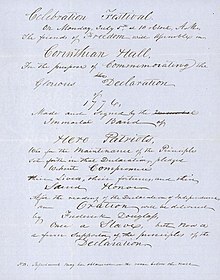
An advertisement for the occasion of the spoken communication.
Fellow-citizens! at that place is no matter in respect to which, the people of the North have allowed themselves to exist so ruinously imposed upon, every bit that of the pro-slavery character of the Constitution. In that instrument I hold there is neither warrant, license, nor sanction of the hateful thing; but, interpreted as it ought to exist interpreted, the Constitution is a GLORIOUS Freedom DOCUMENT. Read its preamble, consider its purposes. Is slavery among them? Is information technology at the gateway? or is it in the temple? It is neither.
In this respect, Douglass' views converged with that of Abraham Lincoln's[15] in that those politicians who were saying that the Constitution was a justification for their beliefs in regard to slavery were doing so dishonestly.
However, if slavery were abolished and equal rights given to all, that would no longer be the case. In the end, Douglass wants to keep his hope and faith in humanity loftier. Douglass declares that truthful freedom can not be in America if Black people are still enslaved in that location and is determined that the terminate of slavery is near. Knowledge is becoming more readily available, Douglass said, and soon the American people volition open their eyes to the atrocities they have been inflicting on their beau Americans.
Intelligence is penetrating the darkest corners of the earth. It makes its pathway over and under the bounding main, too every bit on the earth.[9] : 346
Later views on American independence [edit]
The spoken language "What to the Slave Is the Fourth of July?" was delivered in the decade preceding the American Ceremonious War, which lasted from 1861 to 1865 and achieved the abolitionism of slavery. During the Civil War, Douglass said that since Massachusetts had been the starting time state to join the Patriot cause during the American Revolutionary War, black men should go to Massachusetts to enlist in the Union Regular army.[xvi] Later on the Civil War, Douglass said that "nosotros" had achieved a slap-up matter by gaining American independence during the American Revolutionary War, though he said it was not equally great equally what was accomplished by the Civil War.[17]
Legacy [edit]
In the United States, the speech is widely taught in history and English classes in high schoolhouse and college.[6] American studies professor Andrew Southward. Bibby argues that considering many of the editions produced for educational utilize are abridged, they often misrepresent Douglass's original through omission or editorial focus.[6]
A statue of Douglass erected in Rochester in 2018 was torn down on July 5, 2020—the 168th anniversary of the speech.[18] [nineteen] The head of the organization responsible for the memorial speculated that it was vandalized in response to the removal of Confederate monuments in the wake of the George Floyd protests, though in that location is no evidence to prove this statement. [20]
Notable readings [edit]
The voice communication has been notably performed or read past important figures, including the post-obit:
- James Earl Jones[6]
- Morgan Freeman[6]
- Danny Glover[6]
- Ossie Davis[6]
- Baratunde Thurston[21]
- Five of his descendants[22]
References [edit]
- ^ Douglass, Frederick (1852). Frederick Douglass, Oration, Delivered in Corinthian Hall, Rochester, July 5th, 1852. Rochester: Lee, Mann & Co., 1852. Rochester, NY: Lee, Mann & Co.
- ^ Douglass, Frederick (July 5, 1852). ""What to the Slave is the Fourth of July?"". Retrieved January ii, 2022.
- ^ McFeely, William S. (1991). Frederick Douglass . New York: West.Due west. Norton & Company. pp. 172–173. ISBN978-0-393-02823-ii.
- ^ The paragraphing referenced here is taken from an edition of the oral communication at RhetoricalGoddess
- ^ Douglass, Frederick (1982). Blassingame, John W. (ed.). The Frederick Douglass Papers, Series One: Speeches Debates, and Interviews. Vol. 2, 1847-54. New Haven: Yale University Press. p. 359-387.
- ^ a b c d e f g Bibby, Andrew S. (July two, 2014). "'What to the Slave Is the Quaternary of July?': Frederick Douglass'due south fiery Independence Day oral communication is widely read today, but not so widely understood". Wall Street Journal . Retrieved August 13, 2015.
- ^ a b Heath, Robert L.; Waymer, Damion (2009). "Activist Public Relations and the Paradox of the Positive: A Instance Study of Frederick Douglass's Fourth of July Accost". Rhetorical and Disquisitional Approaches to Public Relations II: 192–215. ISBN9781135220877.
- ^ Battistoni, Richard. The American Ramble Experience: Selected Readings & Supreme Court Opinions, pp. 66-73 (Kendall Hunt, 2000).
- ^ a b c d e f k Douglass, Frederick (1852). "Oration, Delivered in Corinthian Hall, Rochester, July 5, 1852". In Harris, Leonard; Pratt, Scott L.; Waters, Anne South. (eds.). American Philosophies: An Album. Malden, Mass.: Blackwell (published 2002). ISBN978-0-631-21002-three.
- ^ ""What to the Slave Is the Fourth of July?"". Didactics American History . Retrieved 2021-05-22 .
- ^ ""What to the Slave Is the Fourth of July?"". Teaching American History . Retrieved 2021-05-22 .
- ^ Colaiaco, James A. (March 24, 2015). Frederick Douglass and the Fourth of July. St. Martin's Publishing Grouping. ISBN9781466892781 – via Google Books.
- ^ "Exceptionalism and the left". Los Angeles Times. December thirteen, 2010.
- ^ African Americans In Congress: A Documentary History, past Eric Freedman and Stephen A, Jones, 2008, p. 39
- ^ Gorski, Philip (February 6, 2017). American Covenant: A History of Civil Religion from the Puritans to the Present. Princeton University Printing. ISBN9781400885008 – via Google Books.
- ^ Douglass, Frederick. Frederick Douglass on Slavery and the Civil War: Selections from His Writings, p. 46 (Dover Publications, 2014): "Nosotros can get at the throat of treason and slavery through the State of Massachusetts. She was start in the War of Independence; outset to break the bondage of her slaves; first to make the black man equal earlier the police; commencement to admit colored children to her mutual schools, and she was first to answer with her blood the alert cry of the nation, when its upper-case letter was menaced past rebels."
- ^ Douglass, Frederick. Autobiographies, p. 765 (Library of America, 1994): "It was a not bad thing to achieve American Independence when we numbered three millions, but it was a greater thing to salvage this state from dismemberment and ruin when it numbered thirty millions."
- ^ Schwartz, Matthew S. (July 6, 2020). "Frederick Douglass Statue Torn Down On Ceremony Of Famous Speech". NPR. Archived from the original on July 7, 2020. Retrieved July seven, 2020.
- ^ Brown, Deneen Fifty. (July 6, 2020). "Frederick Douglass statue torn down in Rochester, N.Y., on anniversary of his famous Quaternary of July voice communication". The Washington Post. Archived from the original on July seven, 2020. Retrieved July 7, 2020.
- ^ Pengelly, Martin (July vi, 2020). "Frederick Douglass statue torn downward on ceremony of great speech". The Guardian. Archived from the original on July 7, 2020. Retrieved July 7, 2020.
Speaking to WROC, [Carvin] Eison asked: 'Is this some type of retaliation because of the national fever over Confederate monuments right at present? Very disappointing, it'due south across disappointing.'
- ^ Thurston, Baratunde (July 4, 2020) [Recorded July one, 2016]. Baratunde Delivers USA Co-Founder Frederick Douglass 1852 Oral communication: 'What To The Slave Is The 4th of July' . Facebook. Directed by Tara Garver Mikhael. Brooklyn Public Library. Retrieved July 7, 2020.
- ^ "VIDEO: Frederick Douglass' Descendants Evangelize His '4th Of July' Speech". NPR.org . Retrieved 2021-05-22 .
Further reading [edit]
- Bizzell, Patricia (1997-02-01). "The 4th of July and the 22nd of Dec: The Function of Cultural Athenaeum in Persuasion, every bit Shown by Frederick Douglass and William Apess". College Composition and Communication. 48 (1): 44–60. doi:10.2307/358770. ISSN 0010-096X. JSTOR 358770.
- Douglass, Frederick. A Narrative of the Life of Frederick Douglass, an American Slave. New York: Dover Publications, Inc. 1845.
- Douglass, Frederick, ed. Stauffer, John. Random House. 2003. My Chains and My Freedom: Function I - Life every bit a Slave, Part 2 - Life as a Freeman, with an introduction by James McCune Smith. New York: Miller, Orton & Mulligan. 1855.
- Gates, Jr. Henry Louis, ed. Frederick Douglass, Autobiography. New York: Library of America. 1994.
- Oakes, James. The Radical and the Republican: Frederick Douglass, Abraham Lincoln, and the Triumph of Antislavery Politics. New York: W.Westward. Norton & Visitor, Inc. 2007.
External links [edit]
- Frederick Douglass' Descendants Deliver His 'Fourth of July' Speech (video)
- First edition of the publication of Douglass' oral communication
- Discussion of the pamphlet from The Public Domain Review
-
 What to the Slave Is the Fourth of July? public domain audiobook at LibriVox
Source: https://en.wikipedia.org/wiki/What_to_the_Slave_Is_the_Fourth_of_July%3F

Post a Comment for "What Problem Is Douglass Referring to in This Excerpt?"